Popular culture has been fascinated with zombies for a long, long time - I think it's because zombies, unlike other supernatural beings, can be justified through science. At the moment, it's fake science, but a virus that reanimates the meat of a dead person is minutely more probable (in our collective imagination) than a virus that turns you into a wolf. This is speculation on my part, based on the extensive explanations often provided in zombie stories - the rage virus in the 28 Days Later franchise, Max Brooks' examination in World War Z and The Zombie Handbook, and Bill Pullman's turn in The Serpant and the Rainbow, to name a mere handful. Making zombies believable has certainly been more of a focus in zombie media than it has been in, say, vampire media.
This is pretty much the only strength that Jonathan Maberry's Patient Zero has over the plentiful competition.
The novel starts strong with a really neat premise: an Islamic extremist group, backed by a wealthy third party, has developed a highly contagious disease that they intend to release on the American populace. All that stands in their way is a secret government organization (think Men In Black, only with less giving up your entire life) and our Action Hero Joe Ledger. Ledger is part military, part cop, and all badass - his friend-cum-shrink, Randy Sanchez, basically exists to prove how tough and hardened and on the edge of insanity Ledger really is. But you root for him, because he also deals with the terror and sheer bizarreness of the situation.
Ledger is backed mainly by a cast of military personnel, and his personal team is pretty awesome. For the first half of the novel, everyone is tough, ready to rumble, professional, and awesome. They kick ass. Mr. Church, head of the Department of Military Sciences (our super-secret organization) and Major Grace Courtland are a good pair for Ledger to bounce off - collectively, they have enough tactical and practical smarts so that I never felt like leaps of logic were being made without the reader to follow (until the end...but we'll get to that).
It unravels startlingly fast in the second act. It feels as though Maberry loses track of his characterizations; he feels the need to twist his established personalities into several stilted, obvious, and unnecessary storylines, that do nothing for his characters and bog down the pace of the novel. One of his villains, a deliciously amoral representative of the pharmaceutical companies, becomes a completely different person in a really irritating way. The only consistant characters are the most two-dimensional; they can't become something different because there's not a whole lot there to start with.
The other major weakness of the novel is that it changes perspective and place nearly every chapter; this in and of itself is not a criticism, but all of the sections with Ledger are told from a first person perspective while none of the rest of the novel is. This makes the prose tremendously uneven and rather untrustworthy, since the reader doesn't get a consistant narrator to hang on to throughout the story. I understand that to tell the story Maberry obviously wanted to, he can't keep the whole thing in Legder's perspective, but I wish he'd scrapped the first person in favor of a third person omniscient. It would have been smoother AND made more sense.
Long story short: Maberry isn't Max Brooks, and this is no World War Z. I just wish Patient Zero had been satisfying enough on its own that I wouldn't feel the need to make that comparison.
Monday, January 25, 2010

Monday, January 18, 2010
Prospective Reads
I was originally planning to do a fairly academic, drawn out post here about how Neil Stephenson's Snow Crash is not actually cyberpunk, but my smarter-than-me boyfriend has informed me that, in fact, it's categorized as "post-cyberpunk" and not actually the former at all. So. That happened.
(My reasoning was going to be an elegant deconstruction about how the focus of Snow Crash is actually the relationships between people, rather than mankind's relationship to technology and machines, which is what I think the point of pure cyberpunk is. Snow Crash is much more involved in tracing the connecting lines between people, following threads of religion, language, and conformity to show the web that's netting all of us into one big mass of humanity. And then that humanity breeds viruses and programs, I don't know. I stopped outlining what was essentially a college essay when I discovered that this is not a new theory.)
I could ALSO give my excuses for not reading One Hundred Years of Solitude yet, but that one boils down easy: the guy in my office who told me I have to read it, said I need to watch some bizarre film called Gummo first. I haven't watched the film yet, so I haven't read the book yet. I'm going to begin it tentatively, I can tell you that much - I'm no longer intimidated by not finishing books, so if it drags too hard I'm putting it down. But I'm probably being unfair to it; Lord knows that since finishing school I've gotten HELLA lazy in my reading habits.
What I will do is cheerfully tell you to go read The Girl With The Dragon Tattoo, and its sequel, The Girl Who Played With Fire. Wonderful character-driven mysteries, and Larsson the author is a master of story-telling. The fact that they are both translations (Swedish to English) didn't actually impact the prose for me, either (I tend to think translations come out a little stiff, but Tattoo and Fire are both fluid and charming).
(My reasoning was going to be an elegant deconstruction about how the focus of Snow Crash is actually the relationships between people, rather than mankind's relationship to technology and machines, which is what I think the point of pure cyberpunk is. Snow Crash is much more involved in tracing the connecting lines between people, following threads of religion, language, and conformity to show the web that's netting all of us into one big mass of humanity. And then that humanity breeds viruses and programs, I don't know. I stopped outlining what was essentially a college essay when I discovered that this is not a new theory.)
I could ALSO give my excuses for not reading One Hundred Years of Solitude yet, but that one boils down easy: the guy in my office who told me I have to read it, said I need to watch some bizarre film called Gummo first. I haven't watched the film yet, so I haven't read the book yet. I'm going to begin it tentatively, I can tell you that much - I'm no longer intimidated by not finishing books, so if it drags too hard I'm putting it down. But I'm probably being unfair to it; Lord knows that since finishing school I've gotten HELLA lazy in my reading habits.
What I will do is cheerfully tell you to go read The Girl With The Dragon Tattoo, and its sequel, The Girl Who Played With Fire. Wonderful character-driven mysteries, and Larsson the author is a master of story-telling. The fact that they are both translations (Swedish to English) didn't actually impact the prose for me, either (I tend to think translations come out a little stiff, but Tattoo and Fire are both fluid and charming).
Wednesday, October 28, 2009
In which I confess to failure
I've been meaning to put something up sooner, and I even found cover images for two REALLY good Charles de Lint novels (I liked Yarrow more than Angel of Darkness, but that's because I have more of a predilection for fantasy than crime noir) but I haven't for several reasons. Reasons two through seven have to do with how lazy I've been feeling, but the biggest is because I feel like something of a literary failure. And the reason for that is because I didn't like Murakami's The Wind-Up Bird Chronicle.
I didn't like Never Let Me Go by Kazu0 Ishiguro, either, and I think they're related phenomena. They both feature strings of winding narratives, sometimes only vaguely (if at all) connected to each other, and ethereal/metaphysical-thinking characters that I couldn't feel any real attachment to. I'm no stranger to introspection, and I even appreciate it in stories, but I felt like narrative was being sacrificed for the sake of reflection and that doesn't give me much to hold on to. In the spirit of honesty I confess I didn't actually finish Wind-Up Bird Chronicle, but at about 3/4 of the way through it I realized I didn't care what the ending was. It is a chunker of a book, and I'd spent a couple weeks trying to slog through it, and I just couldn't do it any more. I guess I will never know what the secret of the narrator's wife is, or why the hell I had to read that horrible story about killing all the zoo animals. Oh well.
So then I read a string of Terry Pratchett novels, including one I hadn't read before (Thud!) and they were all excellent. I'm partial to Pratchett's novels about the City Watch, because Sam Vimes and Lord Vetinari have some of the best repartee I've ever encountered. Pratchett's books hover on the formulaic, but it's a formula that works - Vimes is a character that demands your respect if not your love, and from me he's got both. Following him through crime and his Batman-esque struggle to stay on the right side of the law is always a brilliant morality play (and you know the bad guy will get it in the end, sometimes by having fireworks crammed in unfortunate places).
I just finished a total absorption with one of John Connolly's mystery novels featuring Charlie Parker, who I'd only known previously from his short story collection Nocturnes. Dark Hallow was a book I waffled on the whole time I was reading it, and then at the very end it delivered me such a sharp dart of clarity that everything I'd had trouble with slotted neatly into place. My original concern had been that Connolly was spreading his resources too thin - there were too many stories, too many characters, and not quite enough holding it all together. The reward at the end is finding out they're all one story, and that every character has a purpose, and that every seemingly-chatty side story fits neatly into the narrative and becomes one cohesive whole. It is a fine bit of storytelling, which is good because I REALLY loved The Book of Lost Things (which you can read about below) and also Nocturnes.
For the moment I'm taking a break, although I'll undoubtedly return to Connolly and Charlie Parker. For now, I'm going to appease the creature-feature lover in me and see about reading The Lost World. I can't really imagine NOT liking it, since Jurassic Park is so awesome, but I guess you never know. Especially with Michael Crichton.
Tuesday, July 21, 2009
Adaptations
In this day and age, it certainly seems like Hollywood can't think up an original idea to save its glittery life. Book-to-movie adaptations are riddling the screen, and are all too often dismissed by literary types because "it'll never be as good as the book." While this is true 98% of the time (I mean, have you READ Jaws? Christ.) it isn't quite fair to the movie makers - books and film are two completely different media. I feel like the mark of a good adaptation is not necessarily complete faithfulness to the source material, because let's face it, that's impossible. A good adaptation is a film that retains the feeling of the book, that captures the intent of the story. It may have to be told in a different fashion, and things will always get left out because of time and visual constraints - what works on paper does not always work on the screen. But this doesn't mean that the movie is wrong, or less valid than the book.
In my lifetime, I have known several truly great adaptations. Jumanji, while a brilliant film and excellent book, is not one of them - I argue that the film uses the book simply as a jumping off point to explore a really neat idea (a boardgame that affects reality). There's so much of the film that was never in the children's book that, at most, the film was inspired by, rather than based off, the book.
Which leads me to my central point: my top five book-to-film adaptations, as based on my opinion and what I described above.
5. A Clockwork Orange
Visually, this film is terrifying, and that's what it had to be. It took the nigh-incomprehensible semantics of the book, which read so twisty and sinister, and spins them into a nightmare landscape whose only real "flaw" is the non-inclusion of the final moments. I happen to think the film ends on a much more haunting note, where the book is perhaps a touch unrealistically uplifting. Alex is much more compelling when he's irredeemable. The "conditioning," scary enough when isolated to print, becomes utterly horrifying when visualized (talk about things you can never unsee), and on the whole the film visually captures the political and social turmoil in a truly excellent way.
4. Coraline
I've already done this comparison, but as a recap: Gaiman's sparse, Victorian story telling puts this gothic fairytale into clear relief, which the film illuminates with brilliant color and breathtaking animation. The few changes the filmmakers made only added to the eerieness of the whole picture, making the two pieces good companions to each other.
3. Harry Potter and the Order of the Phoenix
In my personal opinion, absolutely the best Potter movie that's been made so far (including Half-Blood Prince). Ironically, it's also my least favorite book - all of those long, long pages of Harry suffering teenage angst are remarkably well taken care of in one camera shot. This film also continues the Potter tradition of fantastic casting, with Natalia Tena (Nymphadora Tonks), Imelda Staunton (Dolores Umbridge), and Evanna Lynch (Luna Lovegood) positively stealing their scenes with their perfect embodiments. Lynch as the spacey, goggle-eyed Luna was one of my very favorites. The film showed the darkness descending on the magical world in an exciting way, and made way more of the final battle in the Ministry than I thought they ever could.
2. The Last Unicorn
I couldn't decide whether or not to include this, because it's animated, and then I thought, "why not? I'm making these rules anyway." This happens to be my very favorite book anyway, so one could argue that my standards are higher - and boy, does this deliver. The animation is reminiscent of Miyazaki without being derivative; it is ethereal when it needs to be and earthy, full of emotion. The voice talent is unparalleled, and Christopher Lee as the bitter old King is neither shocking nor disappointing. Angela Lansbury is also brilliant as Mommy Fortuna; the only weak link in the cast is Mia Farrow who plays the Unicorn herself. The film is sweet, sad, and nostalgic in all the right places, just as the novel is; it's a fairytale that reminds us there's magic in the world while hitting bittersweetly.
1. The Lord of the Rings trilogy
I know people who flat out refused to see these films. Because they knew Peter Jackson would never be able to encompass the whole of Tolkien's vision, and because they were terrified that parts they loved (Tom Bombadil) wouldn't make the final edit, they skipped out rather than see something they loved trimmed down and changed for a different audience. Try as I might, I can't get them to understand that this isn't a re-do of Tolkien's fantasy classic, and it's not pretending to do the same things the books do - it CAN'T. But what it did do, I think, was perhaps even more important than that.
The Lord of the Rings (I may be cheating by putting all three films into one bullet point, but it's my blog and I can do what I want) was a cinematic masterpiece. Jackson did something with film that absolutely no one had been able to do before: he internalized a classic story and translated it, slimming it down to the essential plot points and visualizing them in an effective and breathtaking manner. He narrowed the focus, but not the vision; just because you do not get to meet Tom Bombadil doesn't mean you miss out on the fear and uncertainty the hobbits face when setting out from the Shire. It truly encompasses everything that I loved about the books; the tense action and drama of the war, the futility and dystopia of Mordor and Frodo's quest, and the relationships and brotherhoods, love stories and companionships that have been repeated and reused through literary history. They are monuments of film to monuments of literature.
In my lifetime, I have known several truly great adaptations. Jumanji, while a brilliant film and excellent book, is not one of them - I argue that the film uses the book simply as a jumping off point to explore a really neat idea (a boardgame that affects reality). There's so much of the film that was never in the children's book that, at most, the film was inspired by, rather than based off, the book.
Which leads me to my central point: my top five book-to-film adaptations, as based on my opinion and what I described above.
5. A Clockwork Orange
Visually, this film is terrifying, and that's what it had to be. It took the nigh-incomprehensible semantics of the book, which read so twisty and sinister, and spins them into a nightmare landscape whose only real "flaw" is the non-inclusion of the final moments. I happen to think the film ends on a much more haunting note, where the book is perhaps a touch unrealistically uplifting. Alex is much more compelling when he's irredeemable. The "conditioning," scary enough when isolated to print, becomes utterly horrifying when visualized (talk about things you can never unsee), and on the whole the film visually captures the political and social turmoil in a truly excellent way.
4. Coraline
I've already done this comparison, but as a recap: Gaiman's sparse, Victorian story telling puts this gothic fairytale into clear relief, which the film illuminates with brilliant color and breathtaking animation. The few changes the filmmakers made only added to the eerieness of the whole picture, making the two pieces good companions to each other.
3. Harry Potter and the Order of the Phoenix
In my personal opinion, absolutely the best Potter movie that's been made so far (including Half-Blood Prince). Ironically, it's also my least favorite book - all of those long, long pages of Harry suffering teenage angst are remarkably well taken care of in one camera shot. This film also continues the Potter tradition of fantastic casting, with Natalia Tena (Nymphadora Tonks), Imelda Staunton (Dolores Umbridge), and Evanna Lynch (Luna Lovegood) positively stealing their scenes with their perfect embodiments. Lynch as the spacey, goggle-eyed Luna was one of my very favorites. The film showed the darkness descending on the magical world in an exciting way, and made way more of the final battle in the Ministry than I thought they ever could.
2. The Last Unicorn
I couldn't decide whether or not to include this, because it's animated, and then I thought, "why not? I'm making these rules anyway." This happens to be my very favorite book anyway, so one could argue that my standards are higher - and boy, does this deliver. The animation is reminiscent of Miyazaki without being derivative; it is ethereal when it needs to be and earthy, full of emotion. The voice talent is unparalleled, and Christopher Lee as the bitter old King is neither shocking nor disappointing. Angela Lansbury is also brilliant as Mommy Fortuna; the only weak link in the cast is Mia Farrow who plays the Unicorn herself. The film is sweet, sad, and nostalgic in all the right places, just as the novel is; it's a fairytale that reminds us there's magic in the world while hitting bittersweetly.
1. The Lord of the Rings trilogy
I know people who flat out refused to see these films. Because they knew Peter Jackson would never be able to encompass the whole of Tolkien's vision, and because they were terrified that parts they loved (Tom Bombadil) wouldn't make the final edit, they skipped out rather than see something they loved trimmed down and changed for a different audience. Try as I might, I can't get them to understand that this isn't a re-do of Tolkien's fantasy classic, and it's not pretending to do the same things the books do - it CAN'T. But what it did do, I think, was perhaps even more important than that.
The Lord of the Rings (I may be cheating by putting all three films into one bullet point, but it's my blog and I can do what I want) was a cinematic masterpiece. Jackson did something with film that absolutely no one had been able to do before: he internalized a classic story and translated it, slimming it down to the essential plot points and visualizing them in an effective and breathtaking manner. He narrowed the focus, but not the vision; just because you do not get to meet Tom Bombadil doesn't mean you miss out on the fear and uncertainty the hobbits face when setting out from the Shire. It truly encompasses everything that I loved about the books; the tense action and drama of the war, the futility and dystopia of Mordor and Frodo's quest, and the relationships and brotherhoods, love stories and companionships that have been repeated and reused through literary history. They are monuments of film to monuments of literature.
Friday, June 26, 2009
Writing within pre-created universes
Today, I am urging you to do something that might seem a little odd. Scary, perhaps. Or worse yet, a waste of time. But believe me when I say that this is absolutely in your best interest.
Indulge your inner nerd and read a book based off an RPG. Or a video game. Or a war game.
I am absolutely, one hundred percent serious about this. I am currently absorbed in book two of The Eisenhorn Trilogy, a set of books by Dan Abnett based in the WarHammer 40K universe. Gregor Eisenhorn is one of the most frustrating literary characters I have ever encountered, because fundamentally he is a character I want to loathe: as an Inquisitor working for the vast, lumbering Empire he is licensed to do whatever he has to in order to root out heretics, aliens, rogue psychics, and anything else conceived to be a threat to humanity. This includes torture, murder, genocide, and liberal doses of intrigue and info-gathering. Despite all of this, because Eisenhorn is good at his job and immersed up to his elbows in things I find involuntarily repulsive, I DO like him. He's intensely loyal, good to his friends, perceptive and honorable in the Inquisitor way. And as my astute boyfriend has pointed out numerous times, when the alternative to martial law is Chaos and hellfire, theSpanish Inquisition doesn't look too bad.
The Eisenhorn Trilogy so far is entertaining, fascinating from a science fiction and anthropological point of view, and a pretty quick read. You could definitely do worse. Like read Grendel, God forbid. And since I'm pretty much a quintessential nerd, here are a couple other game-based books that I think are fun, interesting, and very entertaining:

Clan War, books 1-7 (Book One: The Scorpion)
By various authors
Based on the RPG Legend of the Five Rings
Why I liked it, and why you probably will too: The L5R RPG is one of the most engaging settings I've ever played, if only for the sheer variety of possibilities that are laid out with almost no difficult thinking on the player's part. The setting is frenetically Asiatic, and the world is clan based with each clan embodying specific characteristics (the Scorpion are sneaky bastards that might poison you, the Lion are unbearably noble and hard-headed, so on and so forth). The Clan War books move through one traumatic event in the L5R setting that shows the best and worst of each clan, while also giving the reader a sample of the history and characters embedded in the setting. They're fun, the characters are fascinating, and the way in which the events of the books interweaves with the fluff in the player's books is artfully done.
 Dragons of A Fallen Sun One in a string of books based on Dungeons and Dragons
By Margaret Weis and Tracy Hickman
Why I liked it, and why you will too: I will be painfully honest here and admit that I have never read the first handful of Dragonlance novels. I tried to get through Dragons of Autumn Twilight about four times before giving up out of boredom. But Fallen Sun is starkly exciting: the main character is a very Joan of Arc-like figure, young and waifish and absolutely fearless. There is a heavy twang of religious fervor hanging around on the pages, that gives even the happy moments a gray wash of fear. I haven't read the books that come after (there are two in the same continuity) but I think I'd like to - Mina, the girl pictured on the cover, performs miracles and gathers soldiers to her side as easily as breathing, and I'm interested to see how her story turns out.
Indulge your inner nerd and read a book based off an RPG. Or a video game. Or a war game.
I am absolutely, one hundred percent serious about this. I am currently absorbed in book two of The Eisenhorn Trilogy, a set of books by Dan Abnett based in the WarHammer 40K universe. Gregor Eisenhorn is one of the most frustrating literary characters I have ever encountered, because fundamentally he is a character I want to loathe: as an Inquisitor working for the vast, lumbering Empire he is licensed to do whatever he has to in order to root out heretics, aliens, rogue psychics, and anything else conceived to be a threat to humanity. This includes torture, murder, genocide, and liberal doses of intrigue and info-gathering. Despite all of this, because Eisenhorn is good at his job and immersed up to his elbows in things I find involuntarily repulsive, I DO like him. He's intensely loyal, good to his friends, perceptive and honorable in the Inquisitor way. And as my astute boyfriend has pointed out numerous times, when the alternative to martial law is Chaos and hellfire, the
The Eisenhorn Trilogy so far is entertaining, fascinating from a science fiction and anthropological point of view, and a pretty quick read. You could definitely do worse. Like read Grendel, God forbid. And since I'm pretty much a quintessential nerd, here are a couple other game-based books that I think are fun, interesting, and very entertaining:
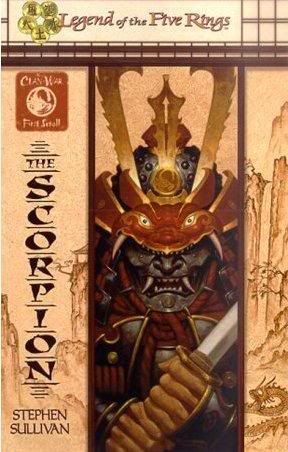
Clan War, books 1-7 (Book One: The Scorpion)
By various authors
Based on the RPG Legend of the Five Rings
Why I liked it, and why you probably will too: The L5R RPG is one of the most engaging settings I've ever played, if only for the sheer variety of possibilities that are laid out with almost no difficult thinking on the player's part. The setting is frenetically Asiatic, and the world is clan based with each clan embodying specific characteristics (the Scorpion are sneaky bastards that might poison you, the Lion are unbearably noble and hard-headed, so on and so forth). The Clan War books move through one traumatic event in the L5R setting that shows the best and worst of each clan, while also giving the reader a sample of the history and characters embedded in the setting. They're fun, the characters are fascinating, and the way in which the events of the books interweaves with the fluff in the player's books is artfully done.
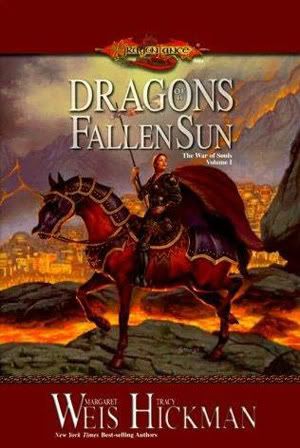 Dragons of A Fallen Sun One in a string of books based on Dungeons and Dragons
 By Margaret Weis and Tracy Hickman
Why I liked it, and why you will too: I will be painfully honest here and admit that I have never read the first handful of Dragonlance novels. I tried to get through Dragons of Autumn Twilight about four times before giving up out of boredom. But Fallen Sun is starkly exciting: the main character is a very Joan of Arc-like figure, young and waifish and absolutely fearless. There is a heavy twang of religious fervor hanging around on the pages, that gives even the happy moments a gray wash of fear. I haven't read the books that come after (there are two in the same continuity) but I think I'd like to - Mina, the girl pictured on the cover, performs miracles and gathers soldiers to her side as easily as breathing, and I'm interested to see how her story turns out.
Sunday, June 7, 2009
The Angel Maker
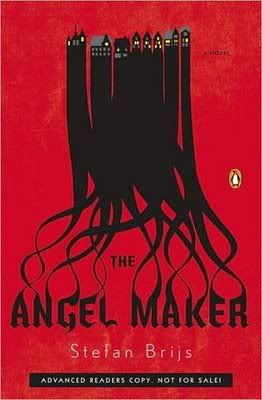
I was quite excited when I picked up The Angel Maker, by Stefan Brijs, from a discount bookstore. The back promised me an eerie, probably viscerally disgusting medical horror, combining science, religion, and playing God in a way that seemed vastly more interesting than Frankenstein ever was. A Belgian novel by origin, The Angel Maker begins promisingly with the introduction of Doctor Victor Hoppe and his three identical, disfigured sons to a small village in Belgium called Wolfheim, and unwinds slowly into a nest of medical ethics versus progress, theological reasoning, and the power of people to rationalize the things that they don't understand.
The Angel Maker suffers from several things, first and foremost from a title that is far too heavy-handed. Much of what seems intended to be later revelations on behalf of the reader are too easily derived from the title and the names of the children, making the moments of what should be understanding towards Dr. Hoppe fall disappointingly flat. The brief on the back of my copy was also insufferably misleading, as this novel is not really about the Frankenstien-ian themes of creating life; it seems intended to show where science and religion cannot cross, taking the ethics of the situation for granted.
The novel also struggles with story-telling, as though Brijs did not have a clear understanding of how he wanted to put the story together. It is divided into three sections, and the first leads off very strongly. The second third is meant to comprise the backdrop to Dr. Hoppe's experiments in Wolfheim, and bounces between his awful childhood, his time in medical school, his previous research, and the events leading up immediately to his transfer to Wolfheim. This mosaic gets increasingly difficult to follow the longer it goes on, so that there are points when I had trouble distinguishing when I actually was in the timeline.
The third section of the novel is obviously meant to be the dramatic spiral downward for the doctor, but it comes too soon - there is not enough buildup to justify Dr. Hoppe's descent into madness. It has been clear through the whole book that he is obsessive and unbalanced, but there is no final tipping point; Brijs does not quite earn the final climactic scene, and so it becomes much less effective than it should be in favor of shock horror.
At its best, The Angel Maker is a fascinating look at genetics and scientific ethics, interspersed with occasional humanizing and touching element (the scenes of the children and their nanny-cum-teacher are poignant in a deeply satisfying way). At its worst, it takes the easy route, going for the cheap shocks and gasps and foregoing the furthering of the real issues. It is, however, intriguing, and a good read for those (like me) who can't seem to stay away from medical horror shows.
Sunday, May 17, 2009
Fairytales
I've just emerged from a long, long period of frantic paper writing, project completion, and the culmination of commencement. I'm no longer soon-to-be-graduating, I am an official college graduate. While this is not an excuse for not posting anything in over a month, it....well, yes, it is an excuse. But bear with me.
John Connolly, in addition to writing very entertaining mystery novels, also writes brilliantly good, dark, edgy fantasy. Today I'm going to tell you why you should go and read his novel, The Book of Lost Things.

The Book of Lost Things is everything a modern fairytale should be. Its main character, David, is a young boy who is neither insipidly precocious nor idiotically naive. He is smart, introverted, and suffers from an abruptly destroyed family when his mother dies from illness. When his father remarries and has the audacity to have another son with the new wife, David escapes into the fantasy of books and an unkempt, sunken garden in the back of the house his father moves them into.
What follows is an adventure worthy of the Grimm Brothers, as David is transported into a fairyworld that takes every expectation you might have and turns it on its ear. Connolly cunningly takes basic fairytale tropes and twists them unexpectedly at the very last minute, leaving you on your toes through the whole novel. The combination of that vein of familiriaty coupled with Connolly's own imagination means that the ending, while somewhat predictable, is still profound and will leave you thoroughly satisfied.
The Book of Lost Things has several winning components: an endearing, likeable, and realistic main character, a frightening and sadistic villain, and an engaging story. I'm about to start Connolly's book of short fiction, Nocturnes, and I'll let you know how that is posthaste.
John Connolly, in addition to writing very entertaining mystery novels, also writes brilliantly good, dark, edgy fantasy. Today I'm going to tell you why you should go and read his novel, The Book of Lost Things.

The Book of Lost Things is everything a modern fairytale should be. Its main character, David, is a young boy who is neither insipidly precocious nor idiotically naive. He is smart, introverted, and suffers from an abruptly destroyed family when his mother dies from illness. When his father remarries and has the audacity to have another son with the new wife, David escapes into the fantasy of books and an unkempt, sunken garden in the back of the house his father moves them into.
What follows is an adventure worthy of the Grimm Brothers, as David is transported into a fairyworld that takes every expectation you might have and turns it on its ear. Connolly cunningly takes basic fairytale tropes and twists them unexpectedly at the very last minute, leaving you on your toes through the whole novel. The combination of that vein of familiriaty coupled with Connolly's own imagination means that the ending, while somewhat predictable, is still profound and will leave you thoroughly satisfied.
The Book of Lost Things has several winning components: an endearing, likeable, and realistic main character, a frightening and sadistic villain, and an engaging story. I'm about to start Connolly's book of short fiction, Nocturnes, and I'll let you know how that is posthaste.
Subscribe to:
Posts (Atom)
