Showing posts with label science fiction. Show all posts

Monday, May 14, 2012

Sci-Fi All The Time

30.  Goliath, Scott Westerfeld
These books are excellent and I'm sad that I've finished them.  This third volume especially gets points for not overwhelming me with the romance story, for introducing Nikola Tesla in all his batshit glory, and for the best illustration of a loris wearing a fake mustache I've ever seen.  If you like steampunk, or alternate history, or war stories, or fun things, you should probably read these books posthaste.

I'm still kind of shocked that Westerfeld wrote both these and the Uglies books.  The level of quality of the writing, the characters, the world building, is so vastly different - Uglies not only isn't on the same level as Leviathan, they don't even occupy the same hemisphere of literature.

31.  Know No Fear, Dan Abnett
The reason to plow through Deliverance Lost is pretty much so you can read Know No Fear.  I was looking at the most current list of Horus Heresy books and their authors, and it's pretty clear that Games Workshop knows where to get the best quality work - of seventeen novel titles (not including short story compilations), four of them are by Abnett and five are by Graham McNeill (I recently finished The Outcast Dead by McNeill).  There are a few others who are definitely quality authors, and I look forward to seeing more of their work (Aaron Dembski-Bowden and James Swallow, particularly), but Abnett and McNeill pretty much have a monopoly on the best titles in this series.  That said, I wasn't fond of the pacing of about the first third of Know No Fear - Abnett writes the book it present tense, and the beginning is SO heavy with foreshadowing that it feels weighty and plodding, rather than tense.  But once the main battle started I was on the edge of my seat - it definitely packs the gut-punching emotional weight and heartbreak that I've come to expect from Abnett.

Tuesday, May 1, 2012

I'm Halfway Through My Project Goal And It's Not Even June Yet

27.  The Outcast Dead, Graham McNeill
I was tired of waiting for someone else to buy the Horus Heresy novels that came out after Prospero Burns, so I bought the next three (The Outcast Dead, Deliverance Lost, and Know No Fear) all at once.  My challenge then was not to read them all in one big sci-fi swallow - because I like spacing series out so that I don't overload myself on one kind of story, and because I don't know when the next volume is coming out and these books are like crack to me.  Seriously, I know the idea of books based off a game property sounds like the end products will be pulpy and bad, but if you're a fan AT ALL of space opera, politics, or robot suits, please read these books.  The Outcast Dead is a really interesting addition to the series, since it shows the reader the fall-out from a specific event that happened a couple of books ago (specifically, you get to see what the astropaths on Terra experience after Magnus pulls his shit in the Golden Throne room).  There's also a ballsy revelation that re-contextualizes large swathes of the whole 40K universe.  In short: shit gets SO REAL.  Also ILU Graham McNeill.

28.  Let's Pretend This Never Happened: A Mostly True Memoir, Jenny Lawrence
The funniest book I have ever read.  No, seriously.  I couldn't read this book in public places because parts of it (especially the chapter on Jenny's adventures with exterminators who don't know what chupacabras are) had me HOWLING with laughter.  If you're a fan of her blog, thebloggess.com, this is a must-read.  If you're not, I don't even know you.

KNOCK KNOCK, MOTHERFUCKER

29.  Deliverance Lost, Gav Thorpe
Oh, Gav.  There's something undeniably cruel about putting a Thorpe book, the weakest of the 40K authors, in between McNeill and Dan Abnett, who are clearly the strongest.  It's a good way to get me to read the damn book, though, especially since the Raven Guard are not really a legion I have much interest in (WHEREFORE ART MY SALAMANDERS, GAMES WORKSHOP?).  But Deliverance Lost has some good story elements in it, and even when I was beating my head against the wall due to stilted dialogue and really bad pacing (it's really bad, you guys) there were still interesting revelations happening.  I'm not sure I really believe the plot point that the book is predicated on, but I have pretty much given up hope on completely logical plot choices in all of the Horus Heresy novels.  I get that there's already an event structure in place that the authors have to adhere to, I do.

(Deliverance Lost starts immediately after the Dropsite Massacre and chronicles Corax's efforts to rebuild his Raven Guard Legion, with a little help from the Emperor [AND NO HELP FROM YOU, ROGAL DORN, GOSH].  Also the Alpha Legion shows up for a while and I vomit a bit in my mouth.  There is some weird Chaos shit that happens, though, and I do love those bits.)

Monday, January 18, 2010

Prospective Reads

I was originally planning to do a fairly academic, drawn out post here about how Neil Stephenson's Snow Crash is not actually cyberpunk, but my smarter-than-me boyfriend has informed me that, in fact, it's categorized as "post-cyberpunk" and not actually the former at all. So. That happened.

(My reasoning was going to be an elegant deconstruction about how the focus of Snow Crash is actually the relationships between people, rather than mankind's relationship to technology and machines, which is what I think the point of pure cyberpunk is. Snow Crash is much more involved in tracing the connecting lines between people, following threads of religion, language, and conformity to show the web that's netting all of us into one big mass of humanity. And then that humanity breeds viruses and programs, I don't know. I stopped outlining what was essentially a college essay when I discovered that this is not a new theory.)

I could ALSO give my excuses for not reading One Hundred Years of Solitude yet, but that one boils down easy: the guy in my office who told me I have to read it, said I need to watch some bizarre film called Gummo first. I haven't watched the film yet, so I haven't read the book yet. I'm going to begin it tentatively, I can tell you that much - I'm no longer intimidated by not finishing books, so if it drags too hard I'm putting it down. But I'm probably being unfair to it; Lord knows that since finishing school I've gotten HELLA lazy in my reading habits.

What I will do is cheerfully tell you to go read The Girl With The Dragon Tattoo, and its sequel, The Girl Who Played With Fire. Wonderful character-driven mysteries, and Larsson the author is a master of story-telling. The fact that they are both translations (Swedish to English) didn't actually impact the prose for me, either (I tend to think translations come out a little stiff, but Tattoo and Fire are both fluid and charming).

Friday, June 26, 2009

Writing within pre-created universes

Today, I am urging you to do something that might seem a little odd. Scary, perhaps. Or worse yet, a waste of time. But believe me when I say that this is absolutely in your best interest.

Indulge your inner nerd and read a book based off an RPG. Or a video game. Or a war game.

I am absolutely, one hundred percent serious about this. I am currently absorbed in book two of The Eisenhorn Trilogy, a set of books by Dan Abnett based in the WarHammer 40K universe. Gregor Eisenhorn is one of the most frustrating literary characters I have ever encountered, because fundamentally he is a character I want to loathe: as an Inquisitor working for the vast, lumbering Empire he is licensed to do whatever he has to in order to root out heretics, aliens, rogue psychics, and anything else conceived to be a threat to humanity. This includes torture, murder, genocide, and liberal doses of intrigue and info-gathering. Despite all of this, because Eisenhorn is good at his job and immersed up to his elbows in things I find involuntarily repulsive, I DO like him. He's intensely loyal, good to his friends, perceptive and honorable in the Inquisitor way. And as my astute boyfriend has pointed out numerous times, when the alternative to martial law is Chaos and hellfire, the Spanish Inquisition doesn't look too bad.

The Eisenhorn Trilogy so far is entertaining, fascinating from a science fiction and anthropological point of view, and a pretty quick read. You could definitely do worse. Like read Grendel, God forbid. And since I'm pretty much a quintessential nerd, here are a couple other game-based books that I think are fun, interesting, and very entertaining:

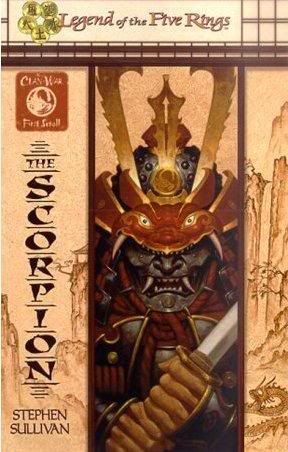
Clan War, books 1-7 (Book One: The Scorpion)
By various authors
Based on the RPG Legend of the Five Rings
Why I liked it, and why you probably will too: The L5R RPG is one of the most engaging settings I've ever played, if only for the sheer variety of possibilities that are laid out with almost no difficult thinking on the player's part. The setting is frenetically Asiatic, and the world is clan based with each clan embodying specific characteristics (the Scorpion are sneaky bastards that might poison you, the Lion are unbearably noble and hard-headed, so on and so forth). The Clan War books move through one traumatic event in the L5R setting that shows the best and worst of each clan, while also giving the reader a sample of the history and characters embedded in the setting. They're fun, the characters are fascinating, and the way in which the events of the books interweaves with the fluff in the player's books is artfully done.

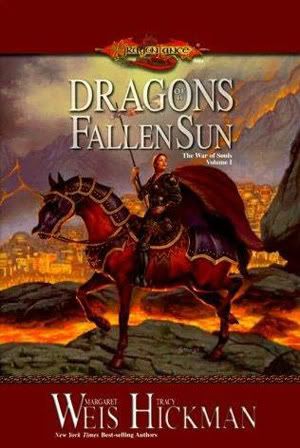
Dragons of A Fallen Sun One in a string of books based on Dungeons and Dragons
By Margaret Weis and Tracy Hickman
Why I liked it, and why you will too:
I will be painfully honest here and admit that I have never read the first handful of Dragonlance novels. I tried to get through Dragons of Autumn Twilight about four times before giving up out of boredom. But Fallen Sun is starkly exciting: the main character is a very Joan of Arc-like figure, young and waifish and absolutely fearless. There is a heavy twang of religious fervor hanging around on the pages, that gives even the happy moments a gray wash of fear. I haven't read the books that come after (there are two in the same continuity) but I think I'd like to - Mina, the girl pictured on the cover, performs miracles and gathers soldiers to her side as easily as breathing, and I'm interested to see how her story turns out.

Sunday, June 7, 2009

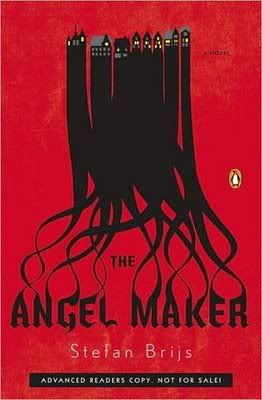
The Angel Maker


I was quite excited when I picked up The Angel Maker, by Stefan Brijs, from a discount bookstore. The back promised me an eerie, probably viscerally disgusting medical horror, combining science, religion, and playing God in a way that seemed vastly more interesting than Frankenstein ever was. A Belgian novel by origin, The Angel Maker begins promisingly with the introduction of Doctor Victor Hoppe and his three identical, disfigured sons to a small village in Belgium called Wolfheim, and unwinds slowly into a nest of medical ethics versus progress, theological reasoning, and the power of people to rationalize the things that they don't understand.

The Angel Maker suffers from several things, first and foremost from a title that is far too heavy-handed. Much of what seems intended to be later revelations on behalf of the reader are too easily derived from the title and the names of the children, making the moments of what should be understanding towards Dr. Hoppe fall disappointingly flat. The brief on the back of my copy was also insufferably misleading, as this novel is not really about the Frankenstien-ian themes of creating life; it seems intended to show where science and religion cannot cross, taking the ethics of the situation for granted.

The novel also struggles with story-telling, as though Brijs did not have a clear understanding of how he wanted to put the story together. It is divided into three sections, and the first leads off very strongly. The second third is meant to comprise the backdrop to Dr. Hoppe's experiments in Wolfheim, and bounces between his awful childhood, his time in medical school, his previous research, and the events leading up immediately to his transfer to Wolfheim. This mosaic gets increasingly difficult to follow the longer it goes on, so that there are points when I had trouble distinguishing when I actually was in the timeline.

The third section of the novel is obviously meant to be the dramatic spiral downward for the doctor, but it comes too soon - there is not enough buildup to justify Dr. Hoppe's descent into madness. It has been clear through the whole book that he is obsessive and unbalanced, but there is no final tipping point; Brijs does not quite earn the final climactic scene, and so it becomes much less effective than it should be in favor of shock horror.

At its best, The Angel Maker is a fascinating look at genetics and scientific ethics, interspersed with occasional humanizing and touching element (the scenes of the children and their nanny-cum-teacher are poignant in a deeply satisfying way). At its worst, it takes the easy route, going for the cheap shocks and gasps and foregoing the furthering of the real issues. It is, however, intriguing, and a good read for those (like me) who can't seem to stay away from medical horror shows.

Thursday, December 11, 2008

Chapter Two: My Nerdly Thesis

Still no review....but soon! For now, I thought I might share with you what I've read over the past four or five months for my senior thesis project. My thesis is a breakdown of science fiction literature that deals with children, and how SF stories that focus on families and children distance the offspring from their parents. I've framed that distance in the overarching theory that, unlike technology (which can be planned, analyzed, predicted, etc.) children cannot be predicted. Even when they're genetically planned, or designed, there's no guarantee that what pops out of one's uterus will resemble its mother.

My reading list:

The Female Man by Joanna Russ. One of the powerhouse writers of the 1970's, Russ' Female Man shows the feminist utopia at its finest. Four different women from four different universes (in time, not space) portraying different aspects of the struggle against patriarchy - a world where the Great Depression never ended and Jeannine is being squashed into marriage or desolation, Joanna who occupies the 1970's as a feminist battling gender expectation, Janet whose planet Whileaway suffered a gender-specific plague 800 years ago, and Jael the assassin in a war between men and women that has waged for fifty years at least. Janet, who lives in a world that has been completely without men for 800 years, seems to have the perfect situation, but I remain skeptical - her family environment is so disconnected and breeds such fierce independence that there's really no connection to anyone.

Xenogenesis: Dawn, Adulthood Rites, and Imago by Octavia E. Butler. Simply put, a must read for anyone who likes science fiction. Butler deals with issues of identity, feminist power, and what freedom actually means to different people in this trilogy about alien occupation and interbreeding. Her Oankali come to Earth in order to "save" humanity, but the price of their salvation is complete loss of their identity - the Oankali are genetic traders, and the stipulations of their help is that humans accept the interbreeding, and the fact that their children from now on will be constructs of both human and Oankali DNA and features, or they don't breed at all. Did I say they "offered" their help? "Ultimatum" might be a better qualifier.

Darwin's Radio and Darwin's Children by Greg Bear. Radio is Bear at his hard SF best: a plague called SHEVA devastates pregnant women, causing miscarriages. Turns out the virus is actually part of our DNA and is causing the next jump in evolution, which is described in Children with the first generation of these "new children." Bear's biting critique of the government and healthcare works much better in the first volume - the second suffers from sentimentality and an unpersuasive view of how Bear thinks things "should" be. At least, that was my evaluation - the new children behave so fundamentally different from our current society it is impossible not to see how Bear is suggesting we fix our "problems."

Daughters of Earth, edited by Justine Larbalestier. An inspiring collection of feminist-driven short fiction and a critical essay for each one. This was immensely helpful to my project, as the essays are focused on unusual topics and full of rich analysis about the stories. It contains some of the absolute best short stories I have ever read, including "And I Awoke and Found Me Here On the Cold Hill Side" by James Tiptree Jr., a bitter piece about the attraction to the exotic, "Rachel in Love" by Pat Murphy, a heartbreaking look at meddling with science and those it can hurt, and "The Evening and the Morning and the Night" by Octavia Butler, which I rank among her best work. Another story about the fallout of scientific progress and its unforeseen consequences.

(On a side note, I did not mean to get so "sum-up-ish" there.)

Flying Cups and Saucers, edited by Debbie Notkin. Another brilliant collection, of Tiptree Award winners and runners-up in the field of short fiction dealing with the advancement of feminist or gender-relations agendas. "Eat Reecebread" by Graham Joyce and Peter Hamilton, "Grownups" by Ian R. MacLeod, and "Motherhood, Etc." by L. Timmel Duchamp all made into my project; "Reecebread" in particular is an intriguing and troubling piece about human evolution and the fear of difference.

A wide spattering of the Gardener Dozois collections, The Year's Best Science Fiction. A friend of mine commented that he didn't put much stock in those, as they're supposed to represent the best of the genre and who can really make that call? I liked them quite a bit, as even though they may not actually have the "best" stories they definitely represent the widely read, the trends for the year, and in general a good overview of what's being written at the time. Since my project depends on the identification of trends, I found them to be very helpful. And hey, they're absolutely brimming with brilliant stories. I looked specifically at years 2005, 2007, and 2008, but I think any one of them will provide a good read.